
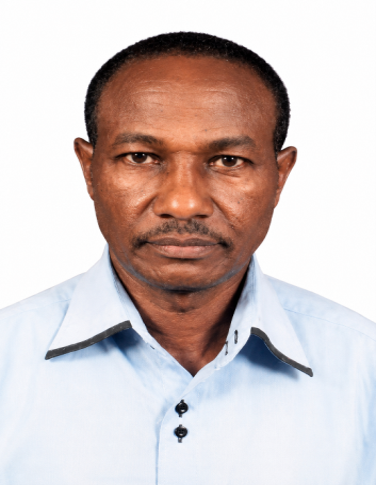
Senior Research Scientist Limnology Science Department Limnology & Aquatic Pollution Organochlorine Pesticides • Water Quality • Fisheries • Blue Economy Email: josephnyaundi@kmfri.go.ke Email: nyaundjo@gmail.com Location Kisumu Station Years of Experience July 1996 to Date (30 years at KMFRI) Research Interests Scientist & Researcher on Aquatic Pollution & Ecologist; Aquaculture, Fisheries Biology & Ecology; Environmentalist; Disaster Management & Humanitarian Assistance; Administrator; Blue Economy resources, Global Information Systems (GIS), Climate Change and Adaption | Research Focus: Monitoring and assessment of organochlorine pesticides residues/degrades in contaminated sites and pesticides risks in aquatic organisms, synthesizing aquatic ecosystems health, fisheries production and aquaculture development in the Blue Economy space. Dr. Joseph Kiyuka Nyaundi is an accomplished environmental scientist and hydrobiologist. He is a Senior Research Scientist (SRS) in the Limnology Science Department at the Kenya Marine & Fisheries Research Institute (KMFRI). He holds a Doctor of Philosophy degree, PhD, in Limnology Science, specializing in monitoring and assessment of organochlorine pesticides residues/degrades in contaminated sites and pesticides risks in aquatic organisms from Kisii University, Kenya, synthesizing aquatic ecosystems health, fisheries production and aquaculture development in the Blue Economy space. He has a research expertise focused mainly on pesticides and trace metals risks on aquatic ecosystems, environmental conservation and impacts of climate change, public health and aquaculture. He received his M.Sc in Sustainable Development from the Masinde Muliro University of Science & Technology (MMUST) focused on synthesis of heavy metals in farmed fish, water and sediment core; and a B.Sc in Zoology from the University of Eastern Africa, Baraton, (UEA), Eldoret, Kenya. He has participated as a Research Scientist in regional and national internationally funded projects, including the Kenya Belgium Joint Project (KBJP); European Union-Lake Victoria Fisheries Research Project (EU_LVFRP), Implementation of Fisheries Management Plan (IFMP) and the Lake Victoria Environment Management Project (LVEMP II) in Lake Victoria Basin. His specific areas of expertise include:
For more details on his professional history and publications, you can view his official ORCID profile: //orcid.org/0000-0002-6214-2616. Research & Administrative Responsibility
Research Interest / Areas of Expertise
Academic Qualifications
Professional Membership
Professional Services
Awards and Honours International Scholarship – United Nations University (UNU), Sponsorship to the Marine Research Institute, Reykjavik, Iceland, for a six months diploma course on 'Marine and Inland Water Resources, Assessment and Monitoring (Aug 2000-Feb 2001) Honoured by KMFRI Director – Successfully act as a Centre Director in one of its Aquaculture Satellite Stations (Kegati Aquaculture Station, Kisii, Kenya: 2003-2006 years) Training Certificate – Wageningen University of Research (WUR), Netherlands, for a postgraduate training course in scientific research analyses (2008) Research Grant – Kenya's National Council Science & Technology (NACOSTI) to support individual MSc training - competitive proposal awarded seed funds for M.Sc field research in 2011 Research Grant – National Research Fund (NRF) to support individual Ph.D postgraduate research work under Kisii University in 2016 KMFRI Best Performance Award – Financial Year (FY) 2017-2018; Awarded by KMFRI CEO and Board of Management (BoM) Certificate Awarded – 26th January 2021; Venue: KMFRI Headquarters, Mombasa in accordance with KMFRI Reward, Recognition & Sanctions policy Peer Review Certificates – Awarded by international peer-reviewed journals and in aquaculture production Selected Publications Christopher M. Aura., Ruth L. Mwarabu., Hezron Awandu., Chrisphine S. Nyamweya., Venny M. Mziri, Joseph K. Nyaundi..... (2026). 'Changes in aquaculture productivity and social inclusion among smallholder households associated with integrated project interventions'. J Sci Afri, Elsevier: Ref/ID: SCIAF-D-26-03138 Basweti George Morara; Nyaundi Joseph Kiyuka; Mwamburi Job Mghanga; Gichuru Nicholas; Nyamweya Chrispine Sangara. (2026). 'Comparative assessment of nutrient dynamics and eutrophication risk of urban stressors on riverine water quality and downstream receiving waters: A Case of Rivers Auji and Kisat, Kisumu, Kenya'. Afri J Aqua Sci. Ref: 268176697; ID: AJAS-2026-0111 Job Mwamburi., Jared Babu Miruka., Fredrick Guya, Peter Wawiye., George Basweti Morara., Joseph Kiyuka Nyaundi......., (2025). 'The Spatio-Temporal Changes in Water Quality and Influences on the Phytoplankton, Zooplankton and Fish Species in Four Large Riverine Ecosystems in Lake Victoria Basin, Kenya'. Asian Journal of Environment & Ecology. 24 (10), pp.14-45. ⟨hal-05286570⟩ Nathan Lenjo Mrombo., Joseph Nyaundi Kiyuka., George Morara Basweti., Christopher Mulanda Aura., Chrisphine Sangara Nyamweya., Venny Mziri Mwainge., Melckzedek Osore (2025). 'Unravelling the causes of the current wild fish kills in Kisumu Bay Fishery of Lake Victoria, Kenya'. Kenya Aquatica Journal. Vol 10, issue No. 01 Nyaundi J., Omasaki S., Babu J., Omondi R., Mwirigi N., Bassa S., and Mwayuli G (2023). 'Dissipation of Environmental Dichlorodiphenyltrichloroethane (DDT) metabolites Concentrations in Surface Water in High Density Populated Areas of South-Western Kenya'. AJAS, 2023: 1-9pp. ISSN 1608-5914 EISSN 1727-9364. https://doi.org/10.2989/16085914.2023.2174930 Christopher M. Aura., Joseph Nyaundi., Nathan L. Mrombo., Melckzedek Osore., James M. Njiru (2023). 'Profiling pesticides concentrations for sustainable lake-use management in Lake Victoria Basin, Kenya: Are they within the recommended limits?'. Kenya Aquatica Journal, Volume 8, Issue No. 01 Nyaundi, J.K (2023). 'Assessment of pesticide levels in water, wastewater, fish ponds and farmed fish in the catchment of River Kuja, Kenya'. PhD Thesis. Kisii University, Kisii, Kenya. 213pp. www.kisiiuniversity.ac.ke Hilda Nyaboke Mogaka, John Okechi, Joseph Nyaundi, Nicholas Gichuru, Monica Achieng Owili, Horace Onyango Owiti, Chrisphine Sangara Nyamweya, Christopher Mulanda Aura, David Mbeva Liti, Vincent Sudoi (2023). 'Emerging frontiers for blue growth in African Great Lakes: the potential for recreational fishing industry in Lake Victoria, Kenya'. Aquatic Ecosystem Health & Management (AEHM), 25(4): 3-11pgs. ISSN: 1463-4988 print/1539-4077 online. DOI: 10.14321/aehm.025.04.03 Links |